



Why Zoho's Co-Founder Shuns Technology for Checklists
- BY Ira Swasti
 In
In  10981
10981 0
0
When TechCrunch, the popular tech blog, says your company’s biggest competitor is Google, you know you’ve arrived and Zoho, a global technology company, finds itself in that lucky spot. Shailesh Davey, the company’s co-founder, along with this three other co-founders boast of a suite of 26 online productivity, collaboration and business applications that have caught global attention. Today, Zoho has around 1,500 people in its main development centre in Chennai, and over six million users. An accidental entrepreneur almost (Sridhar Vembu, Zoho’s other co-founder sold the idea of a tech start-up to Davey in 1996 when he was on his way to an IIM interview), Davey is a blend of tech tycoon and old-world habits. Despite the fancy apps on his iPad and iPhone, he prefers to use a pen and paper to chalk out his to-do lists. He also loves scouting out unconventional routes of hiring, and helping young undergrads polish their skills.
I am a morning person. I wake up around 5.30-6am everyday and head for a workout. My two sons, one in Class 5, and the other in kindergarten are up by then and I usually help them with their homework before getting ready for office. I have a breakfast of porridge and fruits every day.
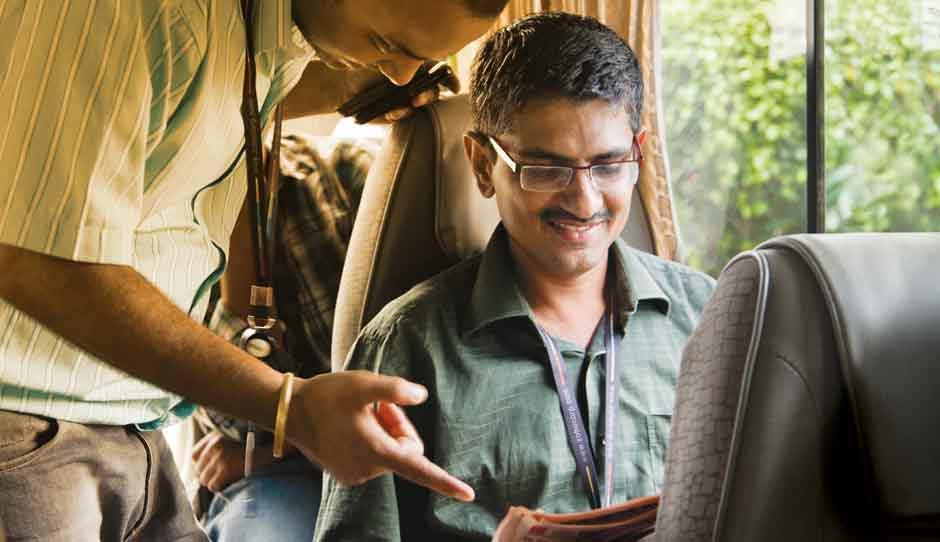
Around 9am, I take a public bus to office. I always carry a copy of 'The Economic Times' to catch up on the news during the half hour it takes me to reach work. Most of the day’s planning takes place on the way as well. I jot down my to-do list on a loose piece of paper. Even though I have an iPad and an iPhone, I am not much of a gadget freak and prefer to use the good old pen to make my list. Mornings are the most productive part of my day. I assimilate the maximum information then and prefer to read all technical and analyst reports first thing when I reach office. That helps me get a feel of where the market is going.
Everyone in the company works on Zoho Mail. But I don’t like to keep my e-mail on for a long time because they just keep pouring in. I check my e-mail once every two hours, otherwise it interrupts my flow of work. As a rule, I definitely check it once in the morning and once before leaving for the day.
 Davey doesn't let email interrupt his flow of work and prefers to make his checklists the old-fashioned way. "I like the visceral feeling of striking out my to-dos."
 There are no cabins in Zoho. It’s an open plan culture with around 1,500 employees in the Chennai office. One set of people comes in at around 8am and leave by 6pm, and there’s another set which comes in by 10am or 11am. We’re a bit flexible with the timings that way though I am not a big proponent of working from home because that does not work for a product-based company like Zoho. We have small teams of around 10-20 people and a lot of knowledge sharing happens on the spot. We like our people to get immersed in that, just turn around and talk to the person sitting next to you. That is not possible if you’re working from home. There’s also a lot of India-US interaction that happens because two of our co-founders work from there.
The benefit of having so many co-founders is a large knowledge pool where each of us can work on an individual aspect of business independently. But you need to share a good chemistry with your partners for this kind of an arrangement to work without friction. Ours has been great because we’ve known each other for years. We’d started the company with around 10 people in 1996 and most of them were family and friends. We have let the requirements of the market help us figure out how to divide the work amongst us.
Since the primary market of our product is in the US, Sridhar and the team there focus on marketing and business development while we in India provide engineering and product support. Sridhar and I touch base once in two days with our teams in India and the US. He talks to the product managers almost on a continuous basis through phone, chat or Skype. A lot of signals are sent from there which need to be assimilated in the products here.
That is one of our key USPs actually because the support is handled by the people who develop the product and because the product is closer to the developer, they get a faster turnaround on support—a very good way of telling the market that the product is developed and supported by the same people.
We’ve put most of our products on the web for free, the idea being that people will try it before they buy it. We don’t spend a lot on sales and marketing, and we tell the customers that whatever we save by not spending on sales and marketing is passed on to them as the benefit of low price.
Another reason for our low pricing strategy are our unconventional hiring techniques. Even though we were from the IITs, we never went back to the IITs to hire. We chose to go to the Tier 2 and Tier 3 colleges to look for unpolished diamonds, if I may use that phrase. A lot of service companies wouldn’t hire these students because their oral communication skills aren’t great. But we are a product-based company so it doesn’t matter much what you speak as long as you’re good with Java and C++. We even conduct our interviews in Tamil, their local language, so that the candidates feel comfortable interacting with us.
In the technology industry, most of the money is made when you're on the edge. It’s much like a race." - Shailesh Davey
In the current technology landscape, whatever you learn is outdated in three to four years anyway. So when we interview a person, we look for a high interest level in learning something new and applying concepts to new problems at hand. He or she doesn’t even have to be a computer engineer—any branch of engineering would do. Most of the people working here are first generation engineers. Their parents have usually worked in agriculture and weaving jobs.
Still, it is very difficult to gauge a person in a 30-minute interview. So we have something called the incubation programme where we give people who may not fit in directly a chance to learn a programming language for a month. And then we observe how they function for three to four weeks before deciding whether to hire them. There’s a food analogy that I like to share about this. Basically, instead of asking people how to cook, we ask them to prepare the dish and taste it.
We get a lot of customer feedback on our online forum called the Zoho Discussions that is hosted on the Zoho website. You can quickly glance through it and get an idea of the mood of the customer. People also use social media a lot these days to give vent to their feelings. I don’t vigilantly track that but sometimes, on a weekend mostly, I’ll search through Twitter, Google Trends and Facebook Alerts to see what people are saying about us.
We also have a separate social media team that monitors these platforms. Being active on the social media today means customer engagement for your business. If someone’s tweeted something good or even bad about the product, the team informs the customer support guys and they may intervene and reply. If it’s an urgent issue, we fix it immediately. If it’s just one customer asking for a certain feature, we may reply saying, we’ll build it into the product roadmap but we don’t know when we’ll roll it out.
Because on the product management side, it’s not just important to know what to do, but also to realise what not to do. If the customer is asking for a certain feature, we see if it’s a customer-specific feature or a market-specific feature. If there are enough customers in the market asking for the same feature, we work on it, develop a beta version and ask them if it meets their requirements.
It’s okay to make mistakes as long as they are not internalised or repeated.
That is why product managers keep a track of their products on each of these forums and unless there’s an escalation where the customer wants to speak to me directly, I don’t prod my team about it. I like to be more of a mentor to our employees than a manager or a boss. We have around 40-50 teams working on a diversity of products. All the discussion or brainstorming on products happens on an internal Zoho forum for employees. We have both company-level and team-level forums where discussions are conducted over chat. Once an idea gets generated and is allocated to someone, it becomes a one-to-one conversation in person.
One of my primary activities as a mentor is to see what good practices are happening in a team and dissipate that information to the other teams. Every job in the company comes with an 80/20 rule—80 per cent of the job you enjoy and 20 per cent of it you have to do, even if you don’t.
Another philosophy I always follow and ask my team mates to follow is—when you ask people to do work, first explain to them why they have to do it. Don’t just give them a command, tell them the reason why they should do it. For instance, if you want something done by the system administration, tell them you have a meeting with a customer at five o’clock in the evening which is why you need that applicationset up. If he or she knows the customer is involved, they will go overboard to do it perfectly.
I usually have a late lunch at my desk around 2.30pm. Post-lunch is a good time to lay out directions for people and resolve issues. I schedule all my meetings and one-to-one interactions with my teams between 3pm and 5pm. In discussions, I don’t like people who lose their temper easily because anger should not play a role in a real dialogue. If I find such a person around, I send him or her some online links on anger management.
Because we’ve grown organically, people have stayed with us for a long time. I give enough freedom to my team mates to commit mistakes and then come back to correct it—the freedom to experiment with products and features, that is. It’s okay to make mistakes as long as they are not internalised or repeated. The lessons they learn from the mistakes they committed are reflected in the new products they develop and you can only reap those benefits if people stay long enough in the company.
In the technology industry, most of the money is made when you’re on the edge. It’s much like a race. Things change very fast in the technology space, and you need to stick your neck out and bet on one horse. If it loses, you have to quickly pull back and move onto another. Honestly, innately, I’m a more structured person. I’d really like to be more unstructured and adaptive to change.
I leave for home around 8-8.30pm, if there are no calls with the US lined up, that is. Before I leave office, I cross out my to-do list. I just love the visceral feeling of striking off tasks that were accomplished from my to-do list before leaving, and then that paper goes into the dust bin. On my way back home, I usually encounter traffic and catch up on more reading on my iPad. I make sure all my reading is done before I get home. I don’t like working at home; that time is wholly reserved for family. In the tech world, you have to make a choice between work and life. If you’re running a manufacturing business, when things are done, you may run the business on auto-pilot. But, you can never really go slow if you’re in the tech field. Things change too fast for you to get complacent. Which is why perfecting work-life balance on a daily basis becomes tough.
So, I look at work-life balance in a weekly context. From Saturday evening till Monday morning, I don’t check my e-mail at all. If I’ve had a rough day in office, I like to pick up some PG Wodehouse or Roald Dahl before going to bed. At 11pm, I am ready to hit the bed and look forward to an early start next morning.
























Add new comment